The chakra mantras are single seed syllables, called bija mantras in Sanskrit, one for each energy centre along the spine: lam for the root, vam for the sacral centre, ram for the navel, yam for the heart, ham for the throat and om for the point between the eyebrows. The crown has no element, and so no element syllable, and in the practice below you meet it with silence. Chanted in order, one sound per breath from the base of the spine upward, they make a simple meditation that moves your attention through the body.
That list is old. A lot of what usually comes with it, the rainbow colours and the promise that each sound fixes a part of your life, is not. Below is the list with its source, what the practice can honestly do, and a ten-minute way to chant it.
The seed syllable for each chakra
In the sixteenth-century Sanskrit text that gave English readers their first scholarly account of the chakras, each centre is a lotus with its own element, and each element has a seed syllable. Here they are from the bottom up:
- Lam: Muladhara, the root centre at the base of the spine. Element: earth.
- Vam: Svadhisthana, the sacral centre, low in the pelvis. Element: water.
- Ram: Manipura, the centre at the navel, often called the solar plexus chakra. Element: fire.
- Yam: Anahata, the heart centre. Element: air.
- Ham: Vishuddha, the centre at the base of the throat. Element: ether, or space.
- Om: Ajna, between the eyebrows, the centre often called the third eye. Here the text places mind rather than an element, and the syllable at its centre is om, which our piece on the meaning of om looks at on its own.
- Silence: Sahasrara, the thousand-petalled lotus at the crown of the head. It carries every letter of the alphabet, but no element and no element syllable.
The vowel in each is a short Sanskrit a, closer to the u in "but" than the a in "lamb", so lam sounds nearer to "lum". The final m is a nasal hum. Let it carry on until the breath runs out.
Where the pairing comes from
The list comes from a Sanskrit text called the Ṣaṭ-cakra-nirūpaṇa, "the description of the six centres". Its author, the Bengali tantric teacher Pūrṇānanda, wrote it as part of a longer work that its English translator, drawing on the author's descendants, dates to 1577. That translator was Sir John Woodroffe, writing as Arthur Avalon, and his 1919 book The Serpent Power is how the text reached English readers.
Read in that translation, the text is more intricate and more unfamiliar than a modern chakra chart:
- It counts six centres, not seven. The title says six, all within the spine, and Avalon calls them the seats of Shakti. The thousand-petalled lotus at the crown sits above them as the abode of Shiva, something of a different order. Count it in and you get the familiar seven.
- The petals carry letters too. Each lotus has a set number of petals, from four at the root to two between the brows, and each petal holds a Sanskrit letter. Avalon points out that the six lotuses have fifty petals between them, one for each of the fifty letters of the alphabet as he counts it. The crown lotus holds all of them, repeated twenty times to make its thousand.
- The colours are not a rainbow. The root lotus is crimson, the sacral lotus vermilion, the heart lotus red like a bandhuka flower, the throat lotus smoky purple and the lotus between the brows white.
- It is not the only scheme. Avalon's own commentary describes further minor centres that this text leaves out, and other Indian traditions count differently.
The rainbow and the list of personal themes came later, and in the West. The composer and author Kurt Leland, who traced this history in a 2016 book and summarised it for the Theosophical Society in America's Quest magazine in 2017, found that one spectrum colour per chakra appeared in the 1930s, and that the rainbow colours and the now-familiar list of qualities (grounding, sensuality or sexuality, empowerment, compassion, communication, intuitive insight, enlightenment) were first combined in print only in 1977, in Ken Dychtwald's book Bodymind and a Yoga Journal article that followed it. So when you chant lam to ram to om, the syllables are the old part. The idea that the heart chakra is green and about compassion is the new part.
If you want more of the background on nadis and the subtle body behind all this, our overview of the seven chakras covers it.
What "unblocking" can honestly mean
The earlier version of this page promised that each syllable would clean out impurities and fix problems from money to relationships. Nothing supports that, and no one has measured a blocked chakra, so there is nothing to show one being cleared. Leland makes a further point: chakra balancing is never mentioned in the old scriptures. In them, the chakras are something to pass through and dissolve, not something to balance.
What those texts describe is a movement upward. Avalon's commentator sums up the principle as the grosser being merged into the more subtle. In the practice the text describes, the yogi leads the coiled power it calls Kundalini up the spine, and at each centre the element is dissolved into the one above it: earth into water, water into fire, and on up. The seed syllables mark the stages of that climb.
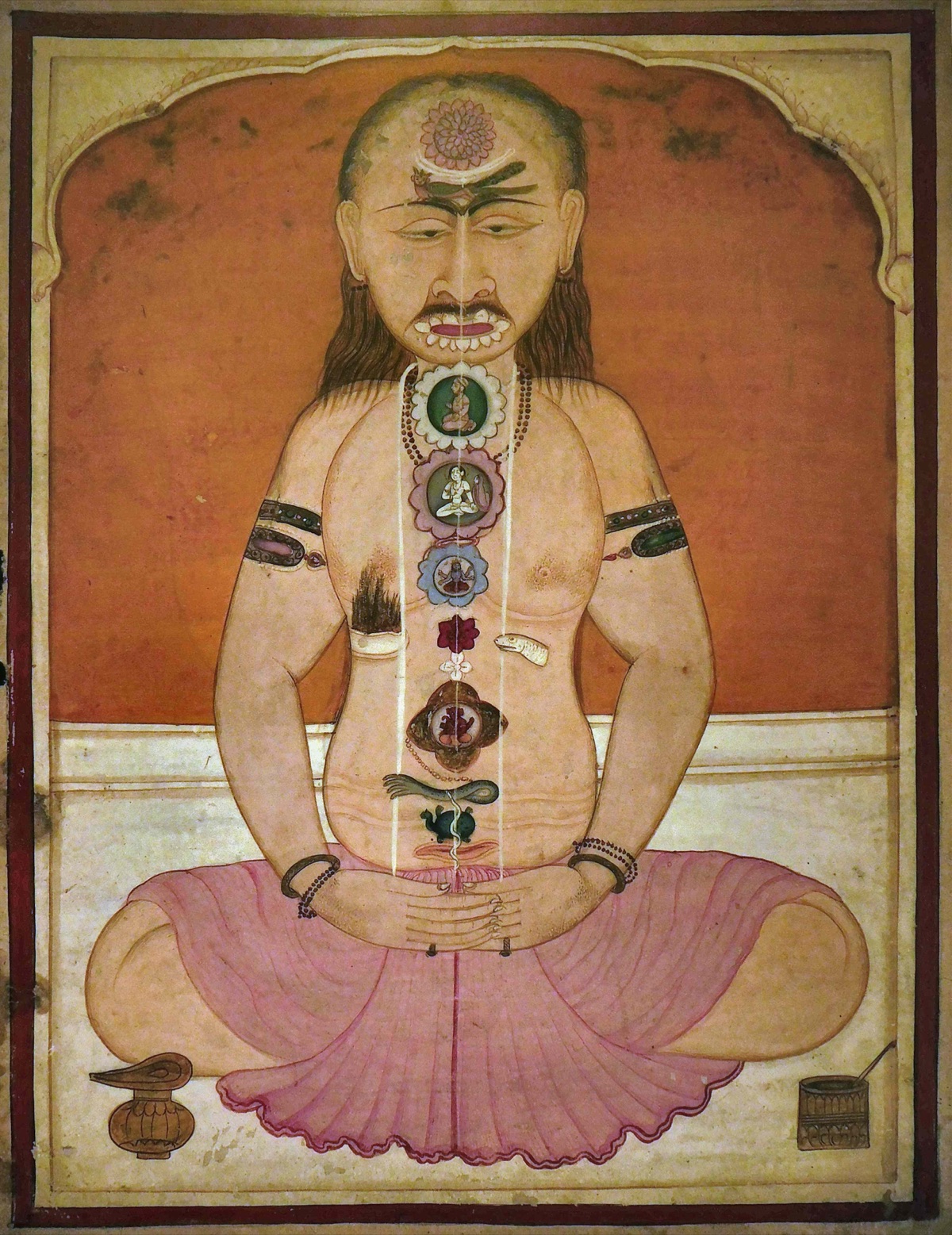
Avalon also warns readers not to take the centres as body parts. They are described as subtle centres in the spinal column that correspond to regions of the body, not as the organs in those regions. Chanting yam is not doing anything to your heart muscle that anyone has measured, and it does not need to.
Put plainly, here is what a chakra mantra practice does. It gives your attention a place in the body and a sound to rest on, then moves both upward in a fixed order. Each time your mind wanders, the next syllable is a clear place to come back to. That is a body scan with sound, and it is a good one. The mantra meditation guide explains what repeating a sound does to a wandering mind, and what the research on mantra practice has and has not found.
How to chant the chakra mantras, base to crown
This takes about ten minutes. One round is seven breaths, one for each centre.
- Sit upright. A chair is fine. Let your hands rest in your lap and close your eyes.
- Root. Breathe in through the nose. As you breathe out, chant lam once, slowly, with your attention at the base of your spine. Let the m hum until the breath is finished.
- Climb. On the next out-breath chant vam with your attention low in the pelvis, then ram at the navel, yam at the centre of the chest, ham at the base of the throat and om between the eyebrows. One syllable per breath.
- Crown. On the seventh breath make no sound. Rest your attention at the top of your head for the length of the out-breath.
- Repeat, getting quieter. Do three rounds aloud, three in a whisper and three in silence, thinking each syllable without saying it.
- Stop. Sit for a few breaths without any syllable and notice how you feel, without deciding beforehand how you should.
A few things people run into:
- You cannot feel the place you are meant to attend to. That is normal. Point your attention at the area and let that be enough.
- You feel light-headed. You are probably stretching the out-breath too far. Breathe normally between syllables and keep the sound comfortable. The breathwork for beginners guide covers pacing.
- You are unsure what pitch to use. Your ordinary speaking voice is fine. You do not need to match a musical note for each centre.
- You lose your place. Start again at lam. With only seven steps, it costs you less than a minute.
Longer chakra mantras, and why seed sounds suit beginners
The one-syllable list is the short version. Because each petal of each lotus holds a letter, a fuller practice can voice those letters too. At the root, for instance, the four petals carry vaṃ, śaṃ, ṣaṃ and saṃ, so a longer root sequence voices those four letters around the central lam. Going through all fifty is a practice you would learn from a teacher, not from a web page.
The earlier version of this page also listed krim, shrim and hrim alongside the chakra mantras, with an effect promised for each. They are real seed syllables used in tantric worship (Avalon's commentary uses krim to show how a seed mantra is built), but they are not the element syllables this text places in the chakras, and the effects promised for them had nothing behind them.
For most people starting out, the short list is the better practice anyway, for four reasons:
- One sound fits one breath. The rhythm is built in, so you are never counting.
- There is no meaning to think about. A syllable like ram is less likely to set off a train of thought than a sentence is.
- It goes silent easily. One syllable is simple to keep hold of in your head once you stop voicing it.
- It has an end. Seven steps and you have finished a round, which keeps you from wondering how long you have been sitting.
Pairing chakra mantras with breath, a mala or a bowl
Breath. Chanting on the out-breath already lengthens it, so there is nothing to add: leave the in-breath alone. If you want to build a longer breath practice around it, start with the breathwork guide above.
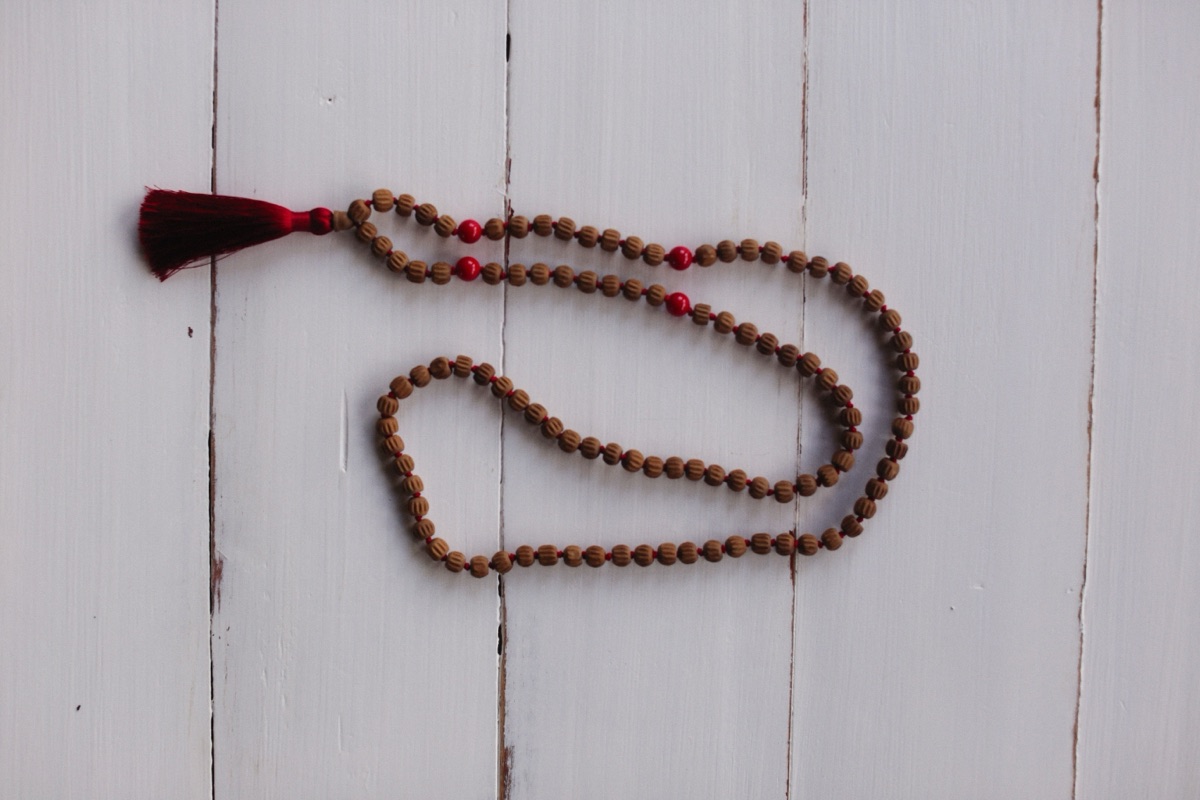
A mala. Seven syllables do not divide evenly into a 108-bead mala, so pick one of two ways to use it. Move one bead per full round of seven if you want a long session with a natural end. Or choose a single centre and repeat its syllable once per bead, working through the full string. How to use mala beads covers holding the mala and turning at the guru bead.
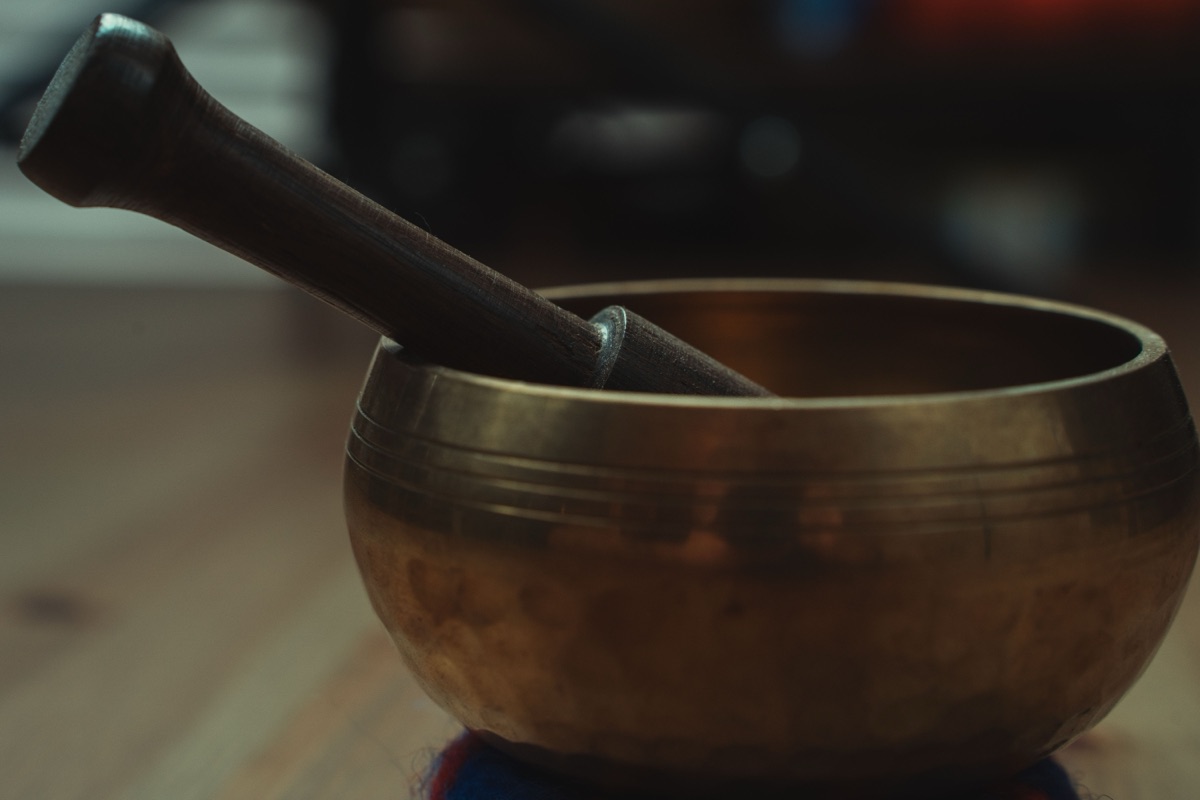
A singing bowl. Strike it once before the first lam, listen until the sound is gone, and strike it again after your last silent round. You do not need a set of bowls labelled by chakra. How to use a singing bowl explains what those labels mean, and how to use a bowl with a mantra.
None of these is required. A quiet room and seven breaths are enough to start, and the practice asks only that you keep bringing your attention back to the next sound.