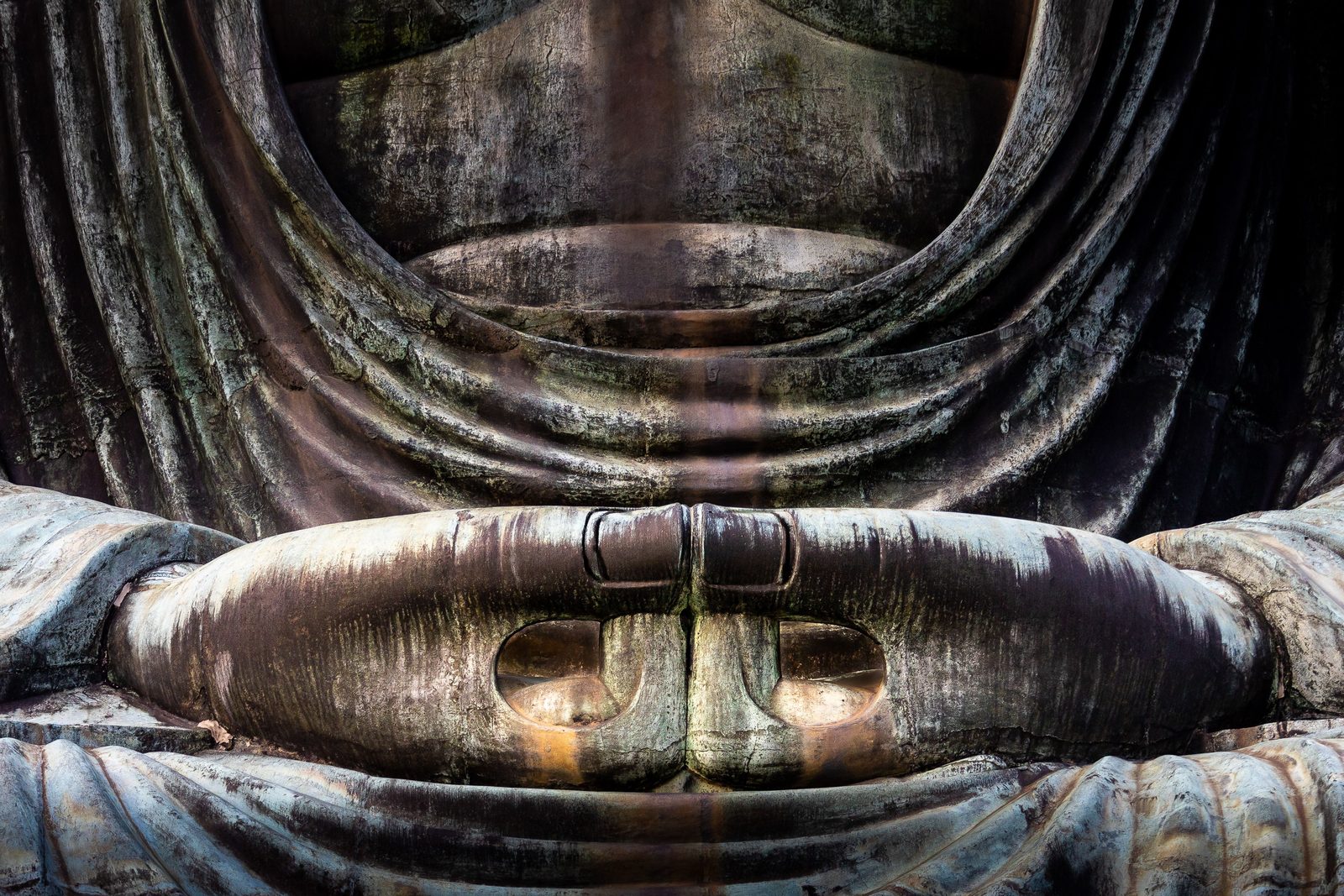
The hand gestures on Buddha statues are called mudras, and each one points to a quality or to a moment in the Buddha’s story. A raised right palm (Abhaya) means fearlessness and reassurance. A lowered, open palm (Varada) means giving. Both hands resting together in the lap (Dhyana) show meditation. The right hand reaching down to touch the ground (Bhumisparsha) shows the moment of his enlightenment, when he called the earth to witness. Both hands at the chest with the fingers making small circles (Dharmachakra) show his first teaching, and a single hand with thumb and forefinger joined (Vitarka) shows teaching and discussion.
Learn those six and a large share of the Buddha images you meet, in a temple, a museum or a garden, will start to make sense.
What a mudra is, and why statues are read through their hands
Mudrā is a Sanskrit word whose first meanings are a seal, a stamp, or the mark a seal leaves. Monier-Williams’s Sanskrit dictionary also gives the religious sense: particular positions and intertwinings of the fingers, practised in worship and believed to carry a hidden meaning. A seal is a good way to think about it. A statue cannot speak, so the hands stamp the scene: this is the Buddha meditating, this is the Buddha teaching, this is the Buddha reassuring you.
That code was not handed down complete. E. Dale Saunders, in Mudrā, his 1960 study of the gestures in Japanese Buddhist sculpture, looked back to the earliest Buddhist sculpture of Gandhara, an ancient region in today’s Pakistan and Afghanistan, and found no sign of a rule yet fixing what each gesture meant. The raised hand of fearlessness could also mean welcome, receiving homage, or preaching, and the viewer read the difference from the objects and figures around it. The rules settled gradually, especially toward the middle of the first millennium CE. So the meanings below are the tradition’s iconography as it came to be standardised, and older or regional images do not always follow them.
The core gestures, one by one
Abhaya: fearlessness
The right hand is raised to about shoulder height, arm bent, palm facing outward, fingers pointing up. It looks a little like a hand held up to say “stop”. Abhaya means without fear, and the gesture stands for protection, reassurance and the removal of fear.
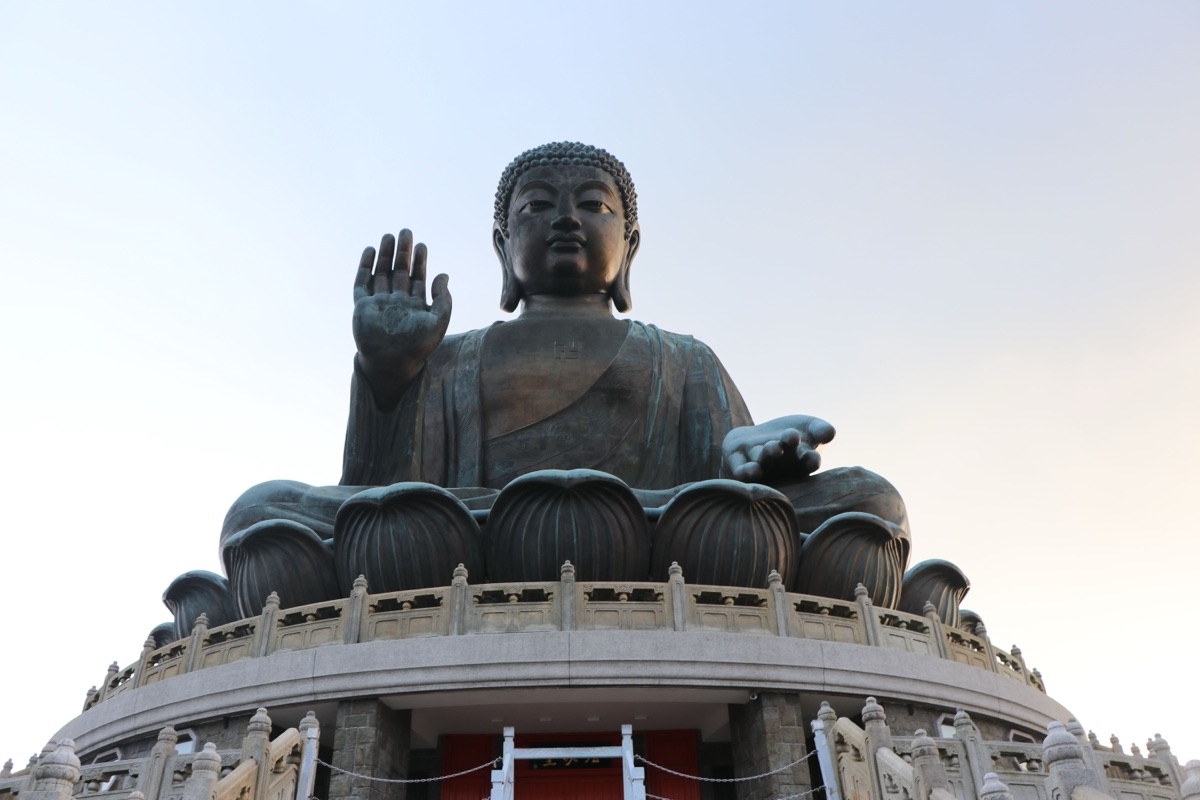
Tradition ties it to a story in which an enraged elephant was driven at the Buddha and his followers. The others ran; the Buddha stood still, raised his hand, and the elephant stopped and bowed. You will see Abhaya most often on standing figures, and in Thailand and Laos on the walking Buddha. The giant seated Buddha on Lantau Island in Hong Kong, pictured above, makes it with his right hand.
Varada: generosity
The hand hangs down beside the leg, palm turned outward, fingers pointing down or slightly bent. Varada means granting wishes or conferring a boon, and the gesture stands for giving, charity and compassion. The Tibetan Nuns Project also reads it as the gift of the teaching itself, and takes the five extended fingers as five perfections: generosity, morality, patience, diligence and meditation.
Varada rarely appears alone. On Buddha images the usual pairing is Varada in the left hand and Abhaya in the right, so that one hand removes fear and the other gives. The same Hong Kong Buddha rests his left hand open on his lap in a gesture of generosity. In Tibetan art, Varada is common on images of Green Tara and White Tara.
Dhyana: meditation
Both hands rest in the lap, palms up, the right hand on top of the left, and the tips of the thumbs lightly touch. Dhyāna is the Sanskrit word for meditation. In Southeast Asian Theravada images the thumbs often lie against the palms instead of meeting.
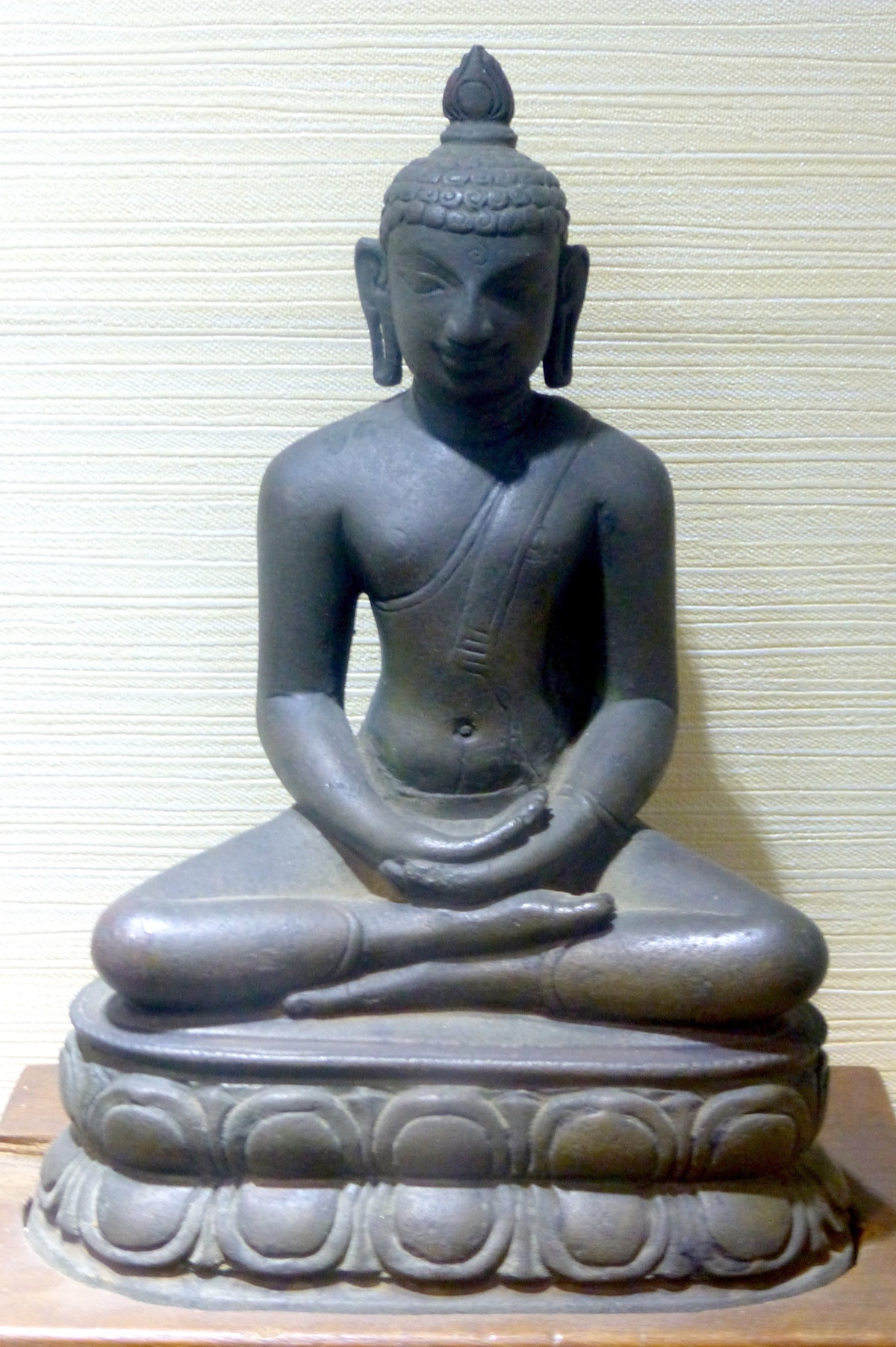
In the story of the enlightenment, this is the position the Buddha held under the bodhi tree while Mara’s armies attacked, and he left it for only one gesture, the next one on this list. Dhyana also marks other figures: Amitabha, the Buddha of the Pure Land, is often shown with it, and the Medicine Buddha is sometimes shown with a medicine bowl resting in his hands.
Bhumisparsha: touching the earth
The Buddha sits cross-legged. The left hand stays in the lap, palm up, as in Dhyana. The right hand drops over the right knee, palm inward, and the fingertips touch the ground. The name is two words: bhūmi, earth, and sparśa, touch. It is one of the most common images in Buddhist art.
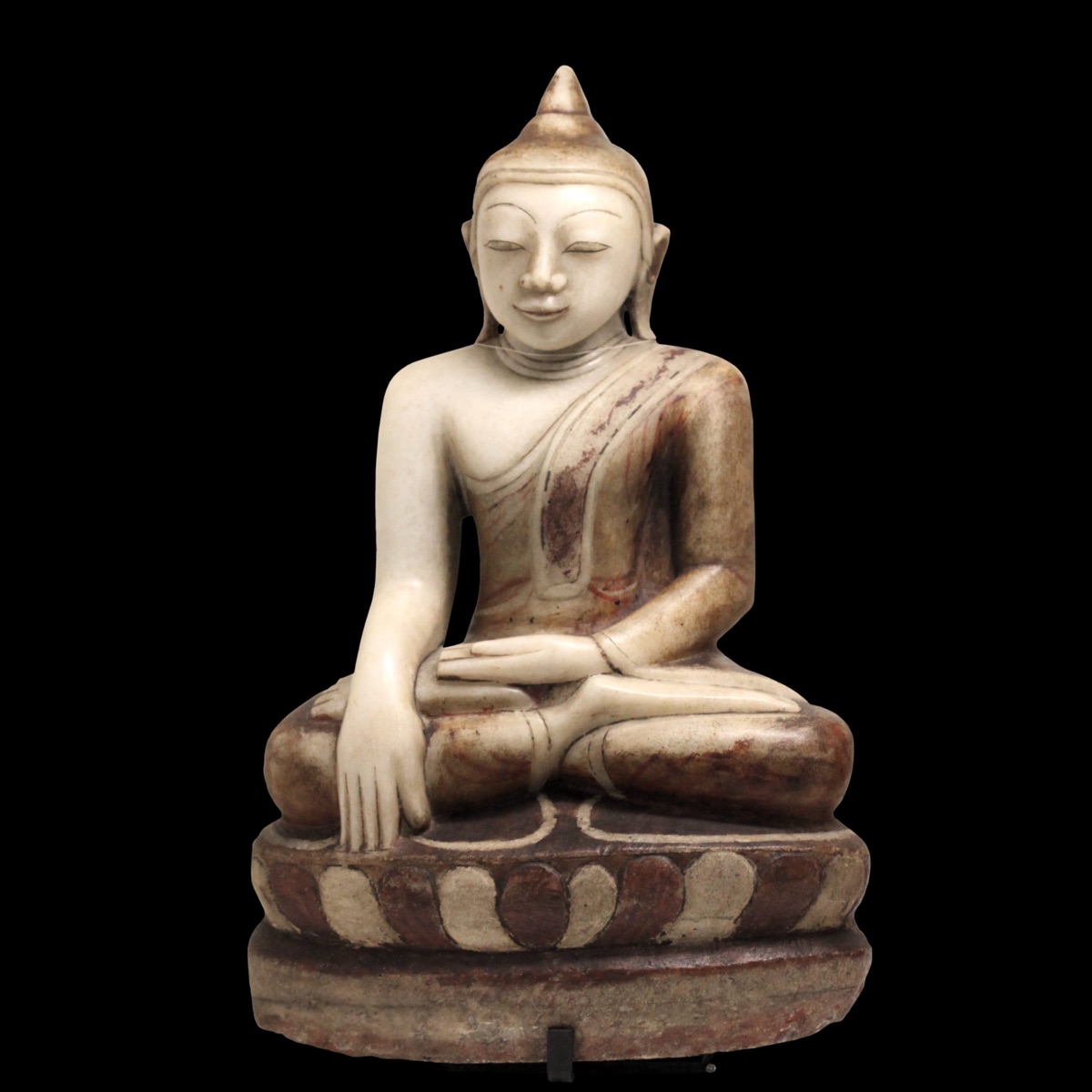
It shows the moment of enlightenment. Mara, the tempter, challenged the Buddha’s right to the seat under the bodhi tree and called his own army as witnesses. The Buddha had no one to speak for him, so he touched the earth and asked it to witness the good deeds of his past lives that had earned him that seat, and the earth, often personified as a goddess, answered for him. In East Asian images the fingers sometimes stop short of the ground; in Indian and Burmese ones they usually reach it.
Dharmachakra: turning the wheel of the teaching
Both hands are held in front of the chest. On each hand the thumb and index finger join in a circle, the right palm faces out and the left faces up or in toward the chest, and the hands are held close together. The name means turning the wheel of the Dharma.
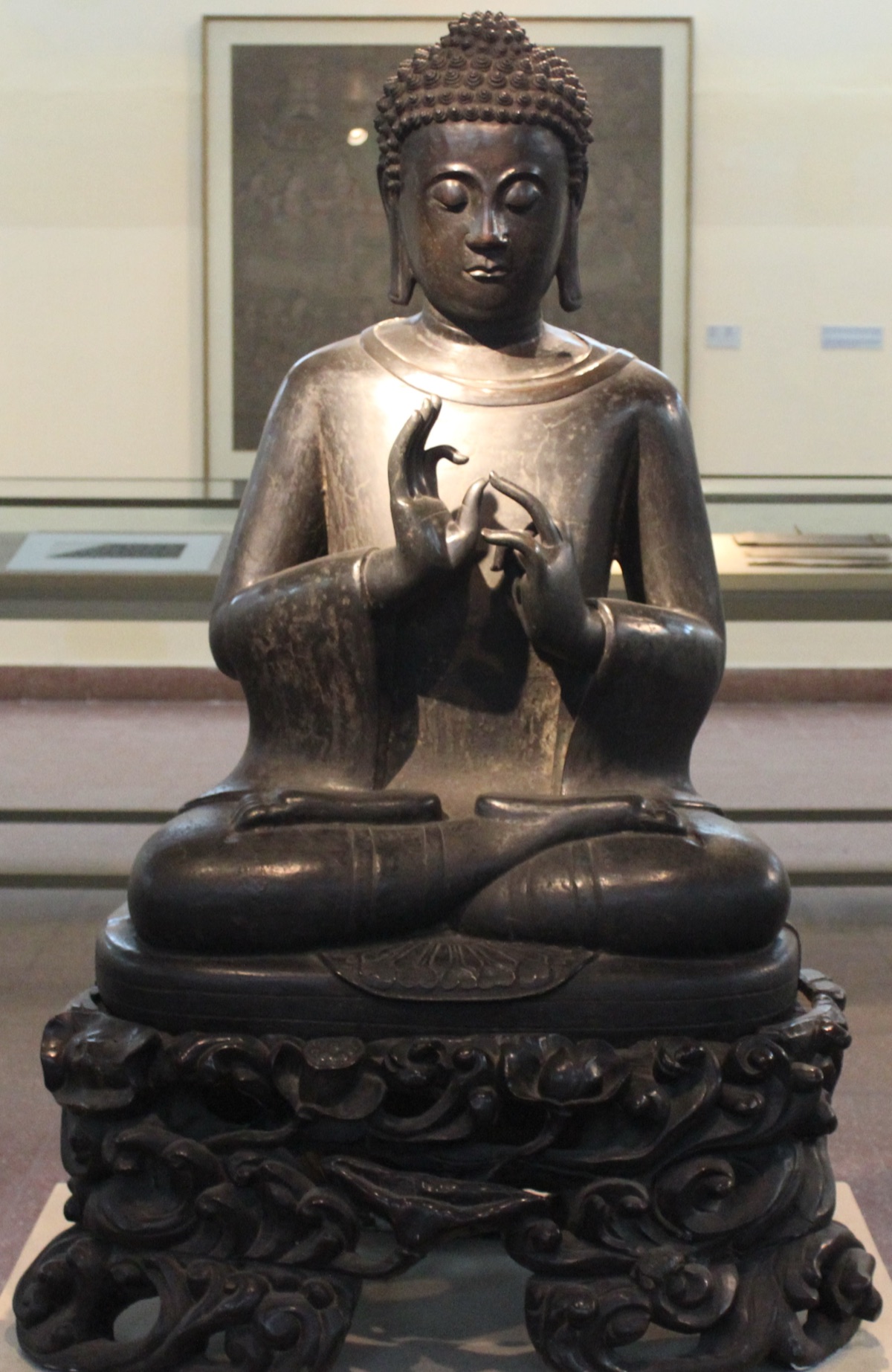
It marks the Buddha’s first sermon after his enlightenment, in the Deer Park at Sarnath near Varanasi, the talk that set out the Four Noble Truths and the Noble Eightfold Path. Before sculptors showed the Buddha in human form, a wheel stood in for that scene, often flanked by two deer. Even after the Buddha took human form in art, the wheel often stayed in the picture, carved on his body or held in his hands. The gesture is generally reserved for the Buddha himself, with Maitreya, the Buddha to come, as an exception. Some old versions, such as the paintings at Ajanta, hold the hands apart.
Vitarka: teaching and discussion
One hand, usually the right, is raised near the chest, palm out, with the thumb and index finger joined in a circle and the other fingers straight. Vitarka means reasoning or deliberation, and the gesture stands for discussing and passing on the teaching. In Tibetan art it is common on Taras and bodhisattvas.
It is easy to mistake for Abhaya or Varada. Look at the thumb: if it touches a finger to make a circle, you are looking at a teaching gesture. If you have been to a yoga class the shape may look familiar; more on that below.
Anjali: reverence
The palms press together in front of the heart, fingers up. Añjali means the open hands held side by side, and by extension reverence and salutation. It is also a common greeting across much of Asia, the gesture that goes with saying namaste.
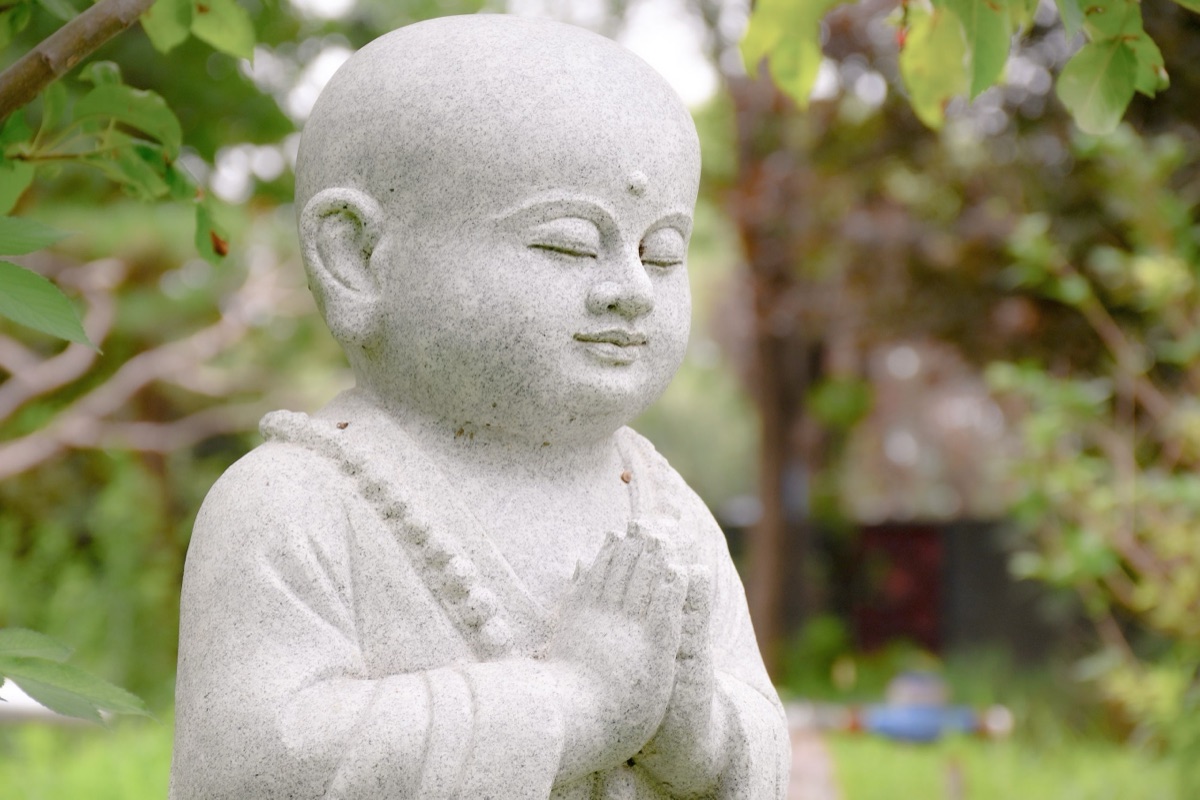
One thing surprises people: Buddha images almost never make this gesture. Anjali belongs to the people facing the Buddha, so you see it on monks, nuns and lay people. A close relative, with the palms slightly cupped around an unseen wish-fulfilling jewel, is a gesture of Avalokiteshvara, the bodhisattva of compassion whose mantra is explained in Om Mani Padme Hum: meaning.
One more name you may meet: Uttarabodhi
Uttarabodhi, supreme enlightenment, holds both hands close to the chest at the level of the heart. Beyond that the descriptions disagree. Saunders records one in which the fingers cross and the index fingers are raised, and another in which each index finger touches the tip of its thumb. Treat it as a family of similar gestures rather than one fixed shape, and do not be surprised when two charts draw it differently.
Reading a statue: the hands, the posture and the setting
A mudra is one clue. Put it together with the rest of the image and the scene usually becomes clear.
- Posture. A seated figure in Dhyana or Bhumisparsha is the meditation and enlightenment story. A standing figure with a raised hand is reassurance. A walking figure with Abhaya is especially associated with Thailand and Laos. A figure lying on its right side most often shows the Buddha’s final passing, though Thai tradition also uses reclining images for other episodes, including one of the Buddha asleep; what the reclining Buddha means goes further.
- Pairs. Two hands can say two things. Abhaya with Varada is protection and giving together.
- Objects. A medicine bowl in the hands can mark the Medicine Buddha. A wheel, especially with a pair of deer, points to the first sermon.
- Place and period. The same gesture takes different forms in India, Tibet, Thailand and Japan, and the earliest images use gestures loosely. When a statue does not match a chart, it is often the chart that is too simple.
For the life story behind these scenes, the legacy of the Buddha walks through it from birth to death.
Hindu and yogic mudras: related, not the same
The word mudra is shared across Hinduism, Jainism and Buddhism, and Hindu and Buddhist images share some of the same gestures. But three quite different things go by the same name.
In temple sculpture, Hindu or Buddhist, a mudra identifies a figure and a moment. In classical Indian dance, hand gestures are a storytelling vocabulary described in the Nāṭyaśāstra, and they have changed over time and vary from region to region. In hatha yoga, the classical mudras are not mainly hand shapes at all. The Haṭhayogapradīpikā, a classic hatha yoga manual, lists ten, and they are whole-body techniques: locks at the throat, the abdomen and the base of the pelvis, an inverted posture, the tongue turned back, practised with the breath held.
The finger mudras taught in many yoga classes today, such as the thumb-and-forefinger circle often called chin or jnana mudra, look like Vitarka but come with a different set of explanations. When a book tells you what a finger position does, it helps to know which of these traditions it is speaking from.
Using a mudra in your own practice: Dhyana mudra for ten minutes
You do not need to be a Buddhist to borrow the simplest of these gestures. Dhyana mudra is a practical place to put your hands while you sit, and it gives you something small to check on as you go.
- Sit so you can stay still. A cushion, a bench or a chair all work. Keep the back upright without stiffening it.
- Place the hands. Rest them in your lap, palms up, right hand on top of the left. Let the tips of the thumbs meet so lightly that they barely touch.
- Set a timer for ten minutes and let the breath move on its own. If you want an anchor, count each out-breath or simply follow the breath in and out. To work with the breath more deliberately at another time, the breathwork guide for beginners starts with five minutes of belly breathing.
- Use the thumbs as a check. If they are pressing hard, soften them. If they have drifted apart, take it as a cue to ask whether your mind has wandered too, then bring the thumbs back together and return to the breath.
- Finish slowly. Open the hands, notice how the body feels, then get up.
If you prefer a sound to the breath, keep the same hand position and silently repeat a mantra instead, as the mantra meditation guide explains. If you like to count repetitions, the hands move to a string of beads; how to use mala beads shows how.
What mudras do not do
On a statue, a mudra is a visual language. It tells you which moment you are looking at and which quality the figure offers: fearlessness, generosity, concentration, a teaching. In esoteric Buddhist ritual, such as Japan’s Shingon school, mudras are also formed during a rite, together with recited formulas and meditation.
That is a long way from the popular claim that a hand position, on its own, routes energy through the body, attracts luck or money, or changes your health. This post does not make those claims, and the statues do not either. What a mudra can do for you is humbler and easy to check for yourself: it gives restless hands a settled place, it marks the start of a sitting, and in Dhyana mudra it gives your attention something small to notice when it wanders.