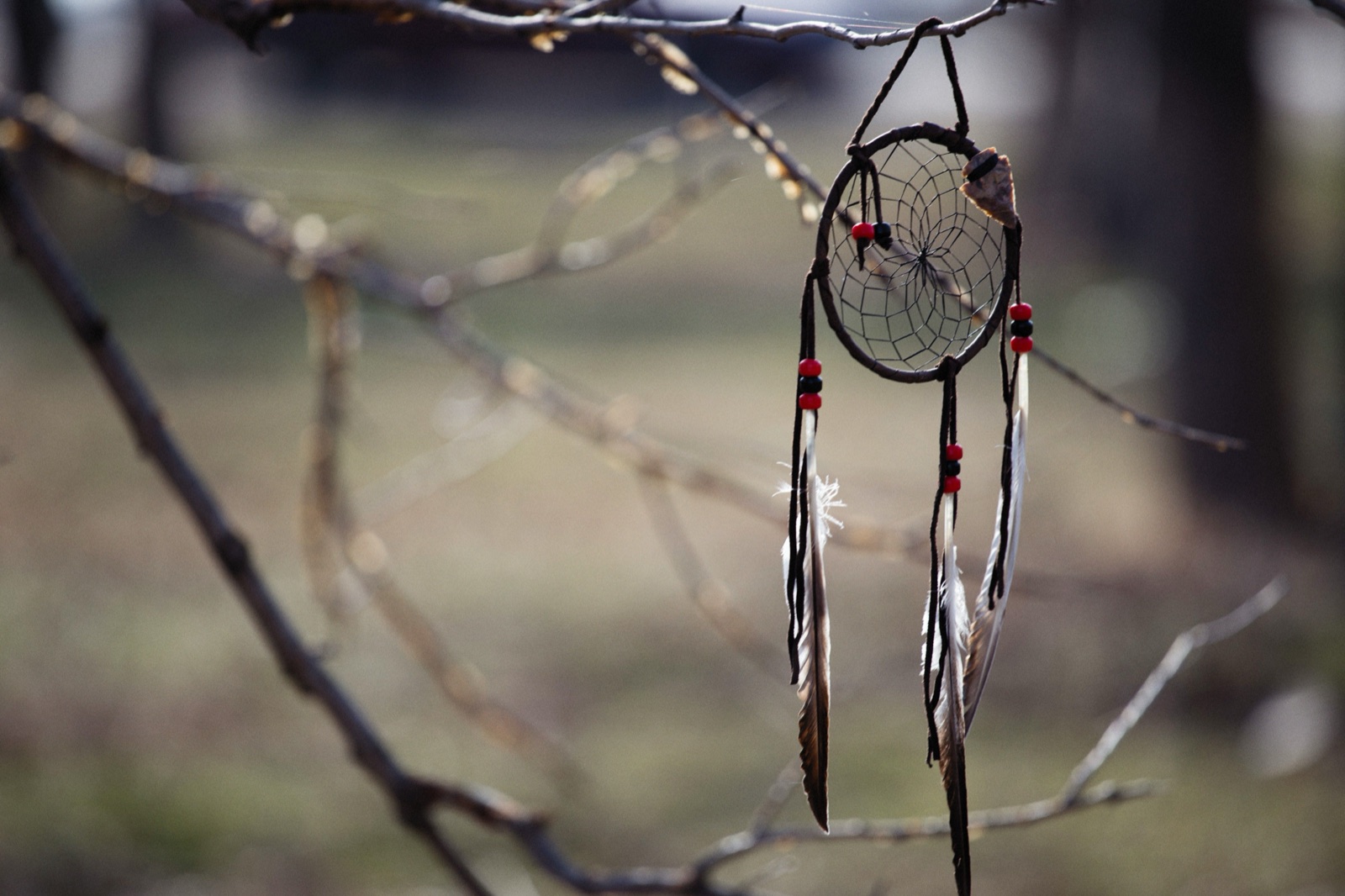
A dream catcher is a small hoop, traditionally bent wood such as willow, with a woven web inside and often a feather or beads hanging from it. It comes from the Ojibwe, an Anishinaabe people of the Great Lakes region, who hung web charms on a baby's cradle board to catch harm before it could reach the child. In an early written record from 1929, protection is its whole purpose. Today it is also explained as a filter for dreams, in Native tellings and gift shops alike, with bad ones caught in the web and good ones slipping through the centre.
What a dream catcher can honestly do in your own home is simpler: mark the end of the day, and remind you to pay attention to your nights.
Where dream catchers come from: an Ojibwe cradle charm
An early written description is in Chippewa Customs, a 1929 bulletin the ethnographer Frances Densmore wrote for the Smithsonian's Bureau of American Ethnology. Chippewa is another English name for the Ojibwe. Densmore describes two wooden hoops about three and a half inches across, each filled with an imitation of a spider's web, that were usually hung on the hoop of a child's cradle board. In earlier times the web was made of nettle-stalk twine dyed dark red with bloodroot juice and the inner bark of wild plum. By the time she was writing, red yarn had taken its place.
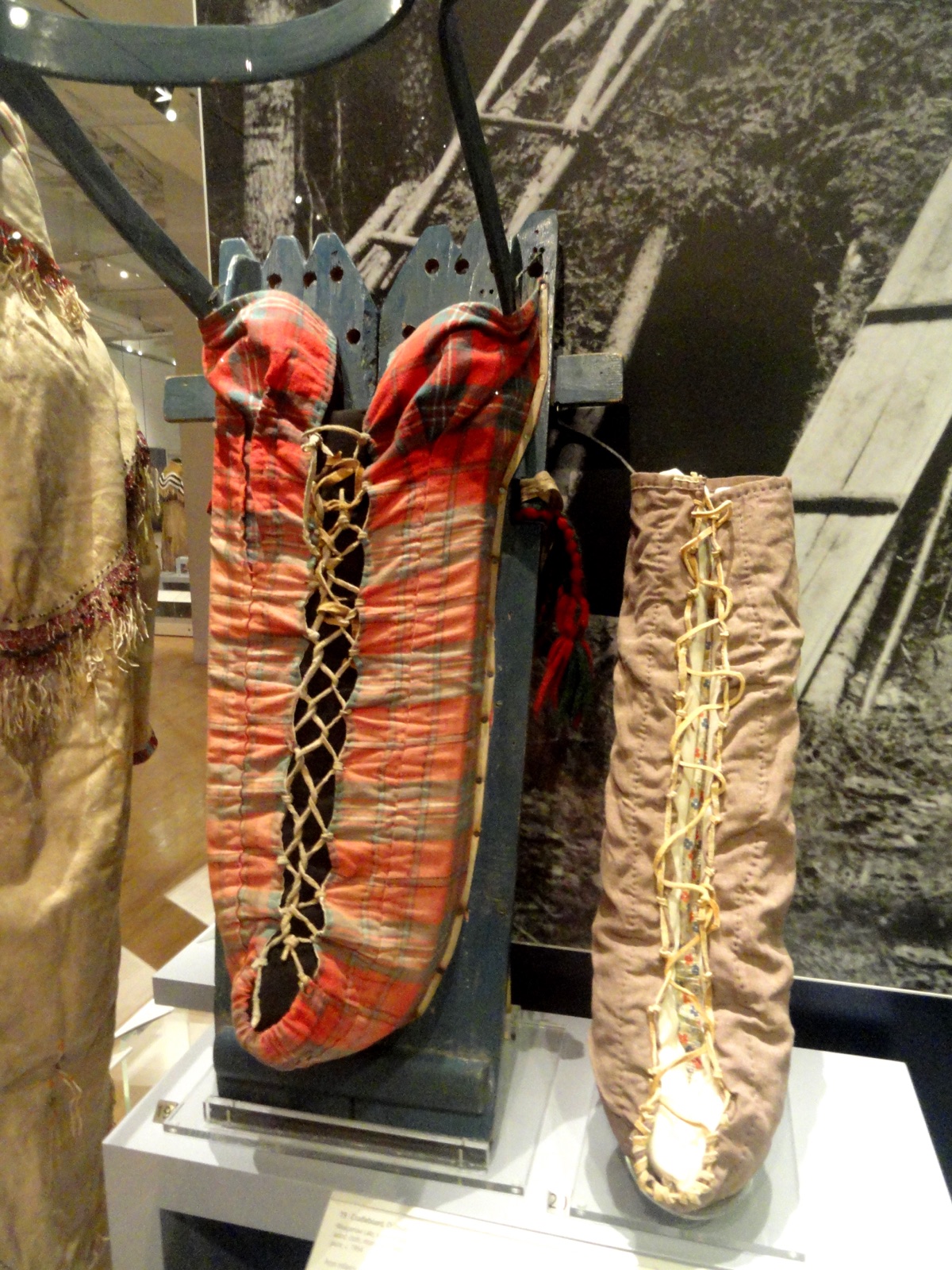
She also recorded how the charm was explained, through the spider. The webs, it was said, caught any harm that might be in the air, the way a real web holds whatever touches it. In this early record the charm guards an infant in its cradle against harm in general, and Densmore's two passages on it do not mention dreams at all.
The Ojibwe language carries the same image. The Ojibwe People's Dictionary, developed with support from the University of Minnesota's Department of American Indian Studies and University Libraries, lists the word for spider as asabikeshiinh and breaks it into a verb meaning "s/he makes nets" plus an ending for a small creature. The dictionary does not connect the word to the charm, but the picture is the same: the spider is a little net-maker, and the charm is a net.
The Spider Woman story
A story often told alongside the dream catcher is about Spider Woman. One version was shared at a workshop at the Alberta Aboriginal Head Start conference in Edmonton, reported in 2001 by the Indigenous newspaper Alberta Sweetgrass. Bev Longboat, executive director of the Niwasa Head Start Program at Six Nations Reserve in Ontario, told it like this: Spider Woman was responsible for the children. She wove the webs and hung them above each baby's cradle board while the infant slept. As the work grew, she could not travel from place to place to look after every child, so she passed the webbing on to the aunties, grandmothers and mothers.
Some modern retellings name her Asibikaashi, and some credit that name to Densmore's 1929 bulletin. It is not in her passages on the web charm. The only Spider Woman she mentions there belongs to a different nation: a Pawnee deity, in a note comparing a similar Pawnee charm. Written versions of the story differ in their details. Read any of them, this one included, as one telling rather than the definitive text.
What the parts of a dream catcher mean
There is no single official key. In the same Alberta Sweetgrass report, Longboat and Alice Noah, originally from Walpole Island in Ontario, described the meanings they teach:
- The hoop. Made of willow and shaped as a circle, which Longboat described as the sun travelling across the earth. A teardrop shape is not unusual either, she said.
- The web and its points. The places where the sinew wraps around the hoop carry meaning. In the original story, Longboat said, there were eight, for Spider Woman's eight legs. Others used seven for the seven grandfathers or the seven prophecies, thirteen for the moons, or twenty-eight for the lunar months.
- The centre. The small opening in the middle of the web is where, in Longboat's telling, good dreams pass through, then filter down the feather into the dreaming minds of the children.
- The feather. The number varies. Some makers use a single feather to stand for knowledge or wisdom. Longboat said the number is entirely up to the maker.
- Beads. The report introduces beads among the things added to dream catchers over time. Noah puts three beads on her work for the Three Fires, the Potawatomi, Ottawa and Chippewa nations.
- Size. Longboat described a traditional dream catcher as three and a half to five inches across, and said a much larger one loses its significance.
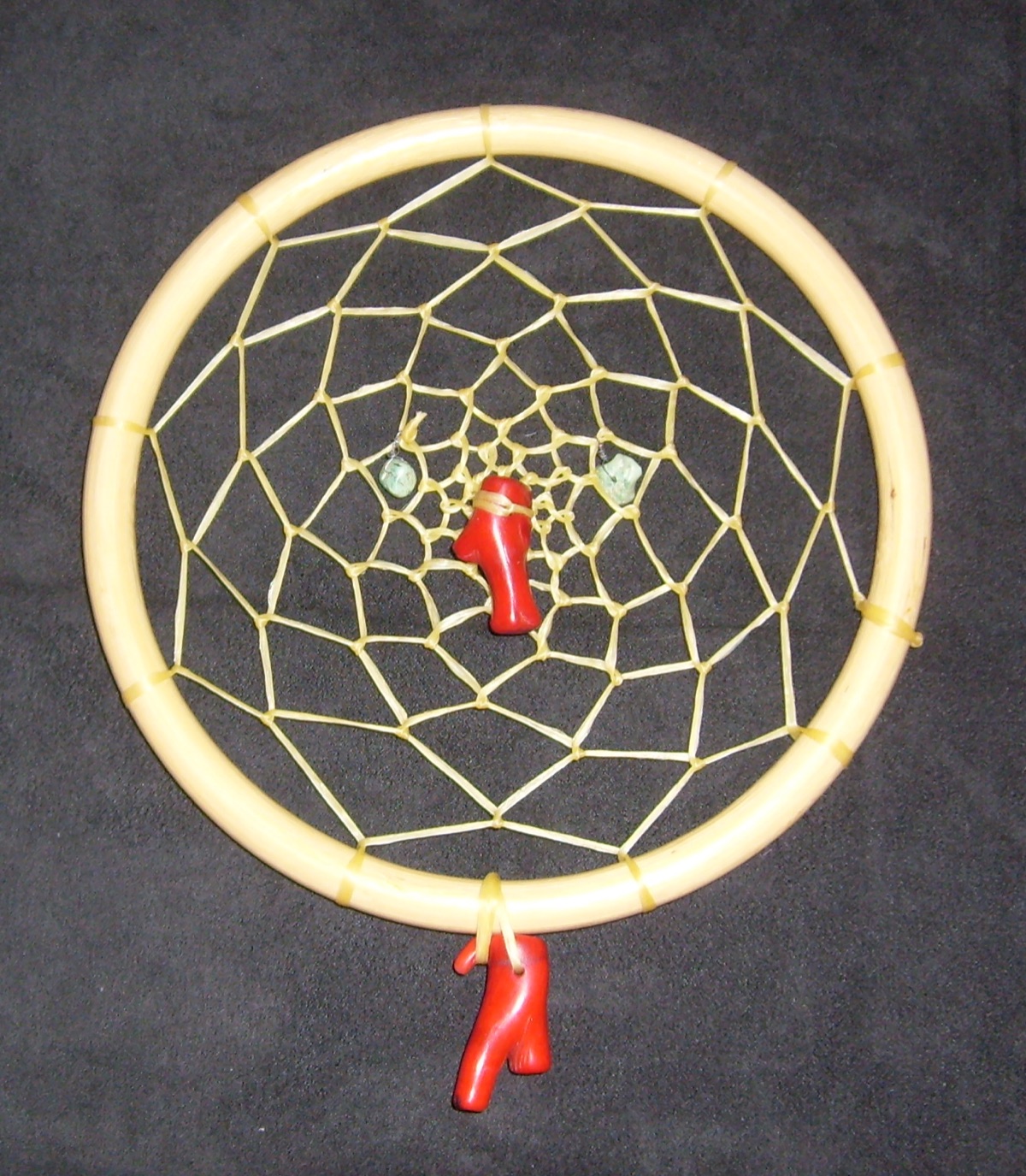
If you are wondering what the colours on a dream catcher mean, none of the sources here gives a colour code. The only colour in Densmore's record is the dark red of the dyed web, and neither Longboat nor Noah assigns a meaning to a colour. Treat a chart that gives every feather or bead colour a fixed meaning as one person's scheme, not a tradition, unless it tells you where it comes from. As Longboat put it: "Just about everything you put on there has a significance, depending on the person doing the webbing."
How the dream catcher spread beyond the Ojibwe
Native Languages of the Americas, a small non-profit that works to keep Native American languages alive, says dream catchers were taken up by other nations during the pan-Indian movement of the 1960s and 1970s, reaching peoples as far from the Great Lakes as the Cherokee, Lakota and Navajo. So, it says, they are not traditional in most Native cultures but neo-traditional, like frybread.
From there the dream catcher moved into gift shops, living rooms and rearview mirrors. The same organisation notes that most of what turns up when you search online for a Native American dream catcher is mass-produced or made by people who are not Native, and often looks only vaguely like the real craft.
Native people do not hold one view of all this. Native Languages of the Americas describes the range: some think of dream catchers as a sweet and loving tradition, some as a symbol of Native unity, and some as kitsch, the equivalent of a plastic Jesus hanging in a truck.
How to own a dream catcher respectfully
An article by Nudrat Karim for The Indigenous Foundation, an organisation founded in 2020 to amplify Indigenous voices, draws the line clearly. It says the appropriation of dream catchers is believed to have begun in the 1970s, with their purpose watered down to "they are hung to catch bad dreams." When non-Native people make and sell dream catchers, it calls that appropriation; when Indigenous people make and sell them, as they always have, it is not. It also says buying one is not forbidden, and asks buyers to support Indigenous businesses. In practice that comes down to a few habits:
- Buy from a Native maker. Look for the artist's name and nation. In the United States, the Indian Arts and Crafts Board keeps a Source Directory of American Indian and Alaska Native owned and operated arts and crafts businesses, listing members of federally recognised tribes and tribally run businesses, and the Indian Arts and Crafts Act makes it illegal to sell a product in a way that falsely suggests it was made by Native people.
- Keep the story with the object. Ask the maker what their version means, and let that be the meaning, rather than a colour chart from a shopping site.
- Do not sell one as Native. If you are not Native, do not make dream catchers to sell, and do not describe a factory-made one as an Indigenous sacred object.
- Hang it where its story puts it. Near where someone sleeps. Every account here places it over a child's cradle, and a bedroom is the nearest thing most homes have.
What a dream catcher can honestly do
Nobody can honestly promise that a web on a hoop will change what you dream, and the early record never promised that either. What it can do is give your bedtime a fixed point. Seeing the same object at the same moment each night can become your own signal that the day is over.
Try this. When you turn out the light, look at the dream catcher and name one thing from the day you are ready to set down. Then say, silently, what you want to carry into tomorrow. Keep it to one sentence, in the spirit of setting a clear intention. If you like to reset a room as well as the day, a simple cleansing ritual with sage pairs well with a new dream catcher. The minutes just before sleep are also where the subconscious reprogramming guide suggests you hold one calm image instead of scrolling.
If bad dreams are frequent, or leave you dreading sleep, speak with a doctor. A dream catcher can sit beside that kind of help, but it is not a substitute for it.
Working with your dreams instead: a morning dream journal
A dream catcher is about the night before. A journal is about the morning after, and it gives you something the charm cannot: a record of what you actually dreamed.
- Set it up the night before. Put a notebook and pen within reach of the bed, open to a blank page.
- Stay still when you wake. Before you reach for your phone or get up, keep your eyes closed for a moment and let the dream come back.
- Write whatever is there. A scene, a face, a colour, a feeling with no story attached. Fragments count. Write in the present tense, as if it is happening: "I am in my grandmother's kitchen and the door will not close."
- Give it a title. Three or four words. Titles make a month of entries easy to scan.
- Read back once a week. Look for what repeats: people, places, feelings. Then ask what in your waking life has the same shape. Treat the dream as your own material rather than a code to crack with a dream dictionary.

Some people find their dreams more vivid and emotional than others do. If that is you, our post on empaths and vivid dreams looks at sensitive sleepers and what to do with what the night brings up.