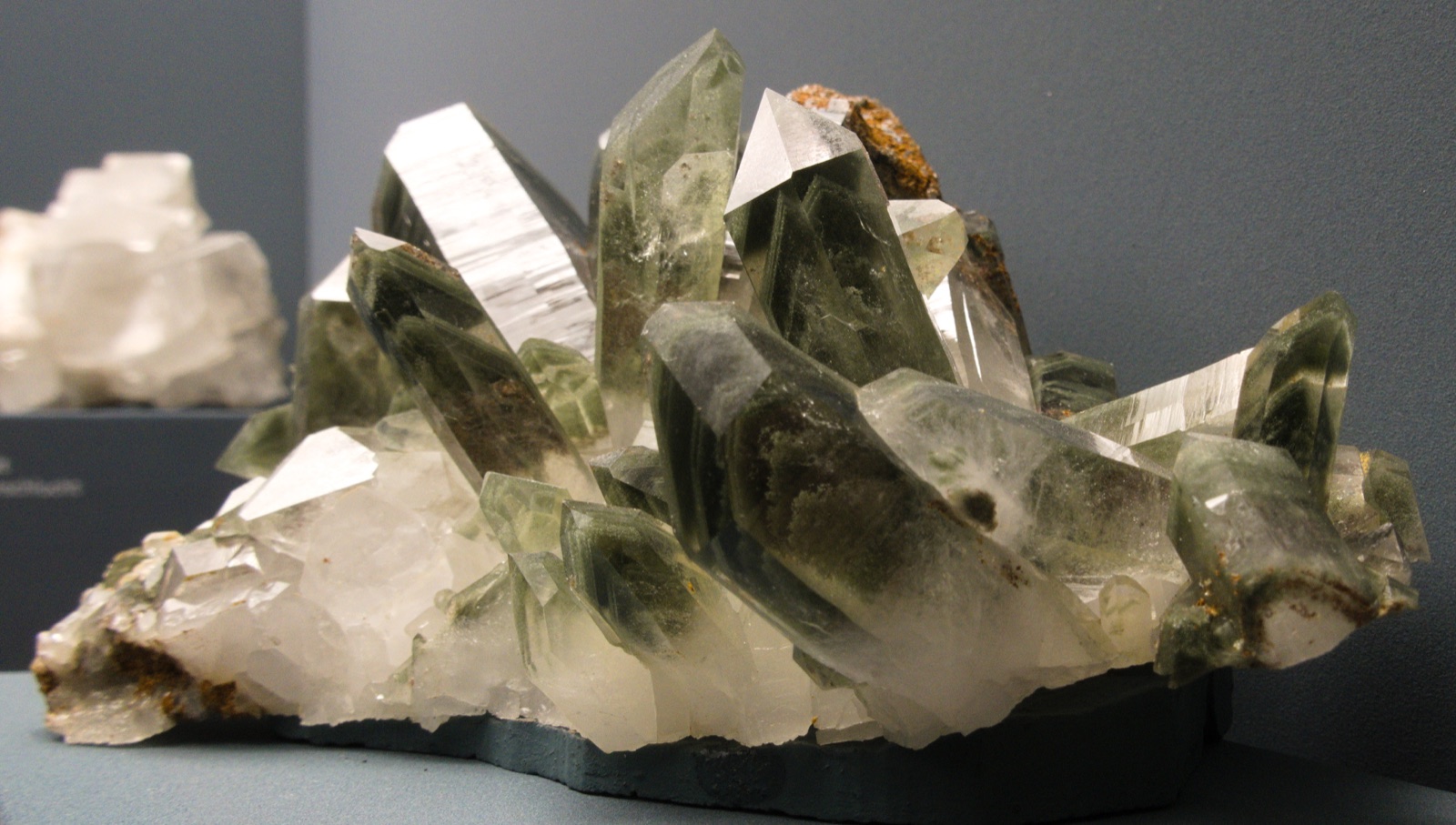
Phantom quartz is a quartz crystal with the outline of an earlier, smaller crystal visible inside it. Sometimes growth paused, a thin film of another mineral settled on the crystal's faces, and new quartz sealed it in, leaving a ghost of the old shape; sometimes the quartz itself grew in a different colour for a stretch. Green phantoms are often chlorite, red ones iron oxides such as hematite, and purple ones bands of amethyst grown into the quartz itself. On crystal sites the stone stands for growth in stages and learning from your past, and those sites tie that meaning to what the inside of the crystal really does record.
This page used to be called "The Healing Powers of Phantom Crystals," and it said the stone could clear negative energy out of your body. It cannot, and that is gone. What replaces it is more interesting: how a crystal keeps a record of its own growth, which minerals make which colours, where the meanings came from, and how to tell a real phantom from a laser-engraved one.
What is phantom quartz?
A phantom is not a separate mineral or a special variety of quartz. It is a feature, a trace of an earlier growth stage kept inside a crystal. Look into a clear quartz point that has one and you see a second, smaller point inside it, often just the pyramid-shaped tip, drawn in a faint haze of colour.
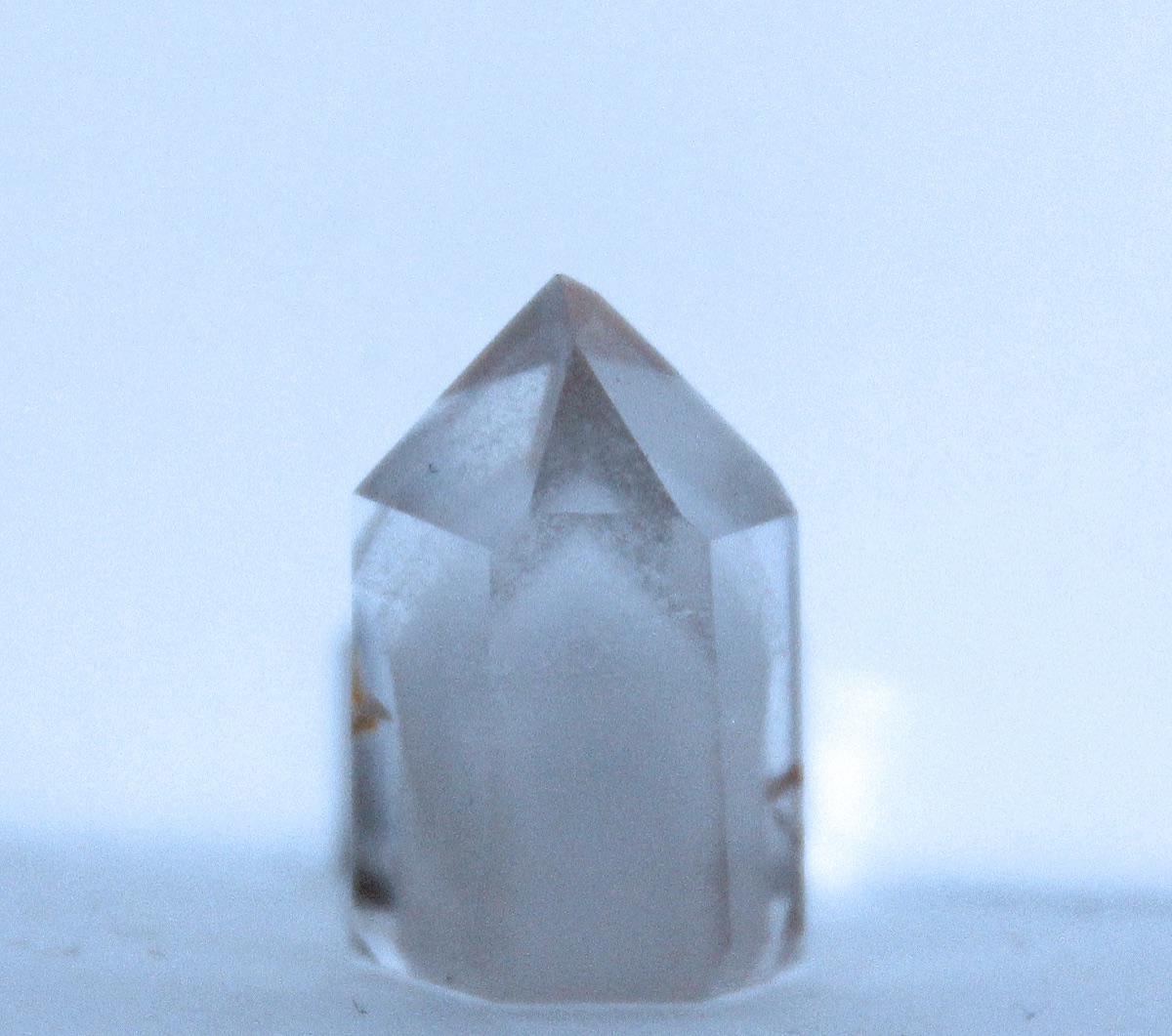
Shu-Hong Lin, Yu-Ho Li and Huei-Fen Chen, writing in Gems & Gemology, the Gemological Institute of America's journal, give a plain working definition: phantom quartz generally means rock crystal with prism- or pyramid-shaped growth zones inside it, which mark early crystal faces that were covered by minerals such as clinochlore, clay minerals, limonite or fuchsite.
How does a phantom form?
Many quartz crystals grow in hydrothermal veins, cracks in rock where hot, mineral-laden water moves through and slowly deposits silica on whatever crystal faces are already there. A phantom made by a mineral coating needs three things to happen in order.
- Growth pauses. The crystal stops adding quartz for a time.
- A film settles. While the crystal waits, fine particles of another mineral dust its faces or grow on them.
- Growth resumes. Fresh quartz buries the film, and the crystal's old surface becomes an inner outline.
John Koivula, describing two quartz crystals from Chile with phantoms made of molybdenite for the same journal, explains them the same way: the molybdenite was deposited on the surface of the quartz, and the host then kept growing, enveloping it as planes that trace the original form of the crystal.
Because the film was lying on real crystal faces, a genuine phantom is oriented the same way as the crystal around it. Lin and his co-authors state it directly: in a true phantom, the axis of the host crystal and the axis of the phantom inside it are the same. That detail is useful when you are checking a piece, and it comes back at the end of this page.
Not every phantom needs a foreign mineral. If trace elements in the water change, the quartz itself can grow in a different colour for a stretch, leaving a coloured zone shaped like the earlier crystal. Mineralogists call this colour zoning. Julian Gray, in an article for the Georgia Mineral Society, gives iron entering a growing quartz crystal as the example that produces amethyst phantoms in colourless quartz.
Green, red, purple and white phantoms: which minerals make the colours
Green phantoms are the ones most people picture. The green is often chlorite. Clinochlore, the first mineral on the list above, belongs to the chlorite group. It is soft and splits into thin, flexible flakes, and the Handbook of Mineralogy gives its colours as grass-green and olive-green among others, noting that its name draws on the Greek chloros, green, for its common colour. Rock & Gem magazine adds actinolite and amphibole to chlorite as minerals that leave green to black dustings on phantom faces.
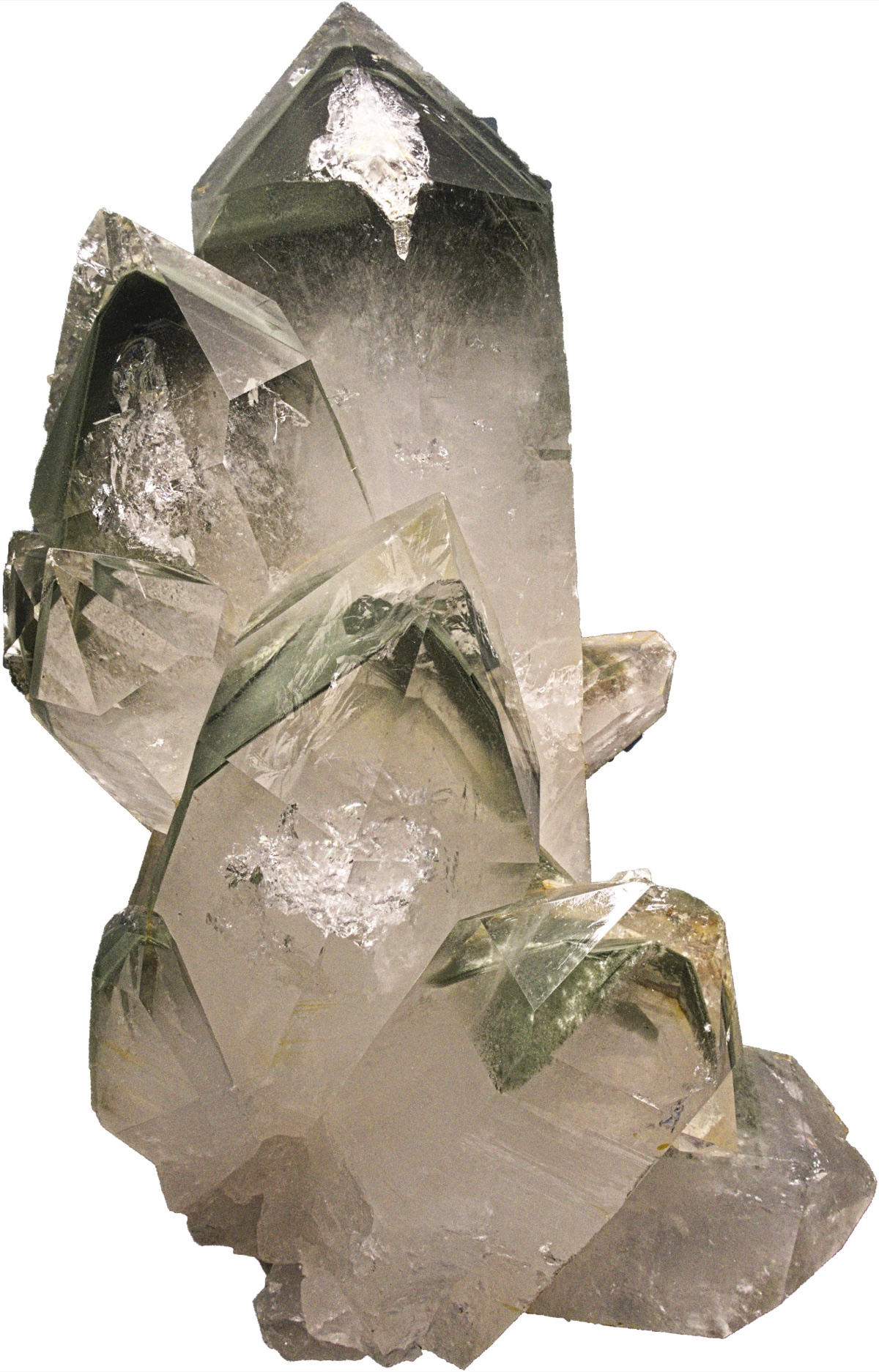
Red phantoms generally point to iron oxides. Rock & Gem describes hematite growing as small red dots or plates that show up as a dusting on a phantom face. The mineral's name comes from the Greek for blood, after its colour.
Purple phantoms are a different kind: colour zoning rather than a coating, a band of amethyst grown inside otherwise colourless quartz. Amethyst's purple is linked to iron. A 2020 laboratory study that heated amethyst in steps related its colour to an absorption band from iron and oxygen, and found the purple gave way to green and then yellow as the temperature climbed.
White phantoms can have more than one cause. Clay minerals are on the Gems & Gemology list of coatings, Crystal Almanac names clay or feldspar, and Rock & Gem notes that tiny bubbles can also be trapped in thin layers along an old growth surface. Telling these apart takes magnification.
What does phantom quartz mean?
The crystal sites we read tell much the same story. The Crystal Council says phantom quartz symbolises cycles of growth and renewal, and that it encourages you to reflect on your past and learn from it. Crystal Almanac calls it a symbol of evolution and of growth through difficulty, and says crystals with several phantoms are associated with many lifetimes of wisdom. The old version of this page said the stone would help you understand the cycles of life and grow from the inside.
Those are trade meanings, written by modern shops and crystal websites. They do not come from mineralogy, and a mineral cannot store past lives. But look at how closely the meaning follows the geology. A phantom really is an earlier form kept whole inside a later one. The crystal grew, stopped, took on something from its surroundings, and then grew around it. An object that carries its own history in plain view is an obvious symbol for having a history of your own.
That is also why the healing claims that used to sit here do not follow from it. The crystal records what happened to it. There is no good evidence that it does anything to the person holding it. The crystals guide sets out what the research on crystals does and does not support, and why a stone can still earn a place in a practice.
How to use phantom quartz to mark a stage of your life
If the meaning comes from the shape, work with the shape. A phantom crystal makes a good object for marking a stage you have come through, or one you are starting.
Name the layer. Choose one stage, not your whole story: the year you left a job, the end of a relationship, the first months of a new habit. Write one sentence about who you were at the start of it and one about who you are now. Keep the paper with the stone.
Give it one moment in the day. The crystals guide makes the case for one stone with one job, used at the same point every day. Here the job might be a pause before a choice the earlier version of you would have made on autopilot. Pick up the stone, find the ghost inside it, and ask which of the two of you is choosing.
Sit with it. Hold the crystal up to a window so the phantom shows. Breathe slowly while your eyes trace the outline from the tip of the inner point out to the tip of the outer one, and back. A few minutes is plenty. The breathwork for beginners guide has simple patterns to pair with it.
Close the stage when it is done. When the stage you named feels finished, say so. Write the date on the paper, move the stone somewhere new, and name the next stage. The crystal does not change. The practice is noticing that you did.
None of this strictly needs a phantom. It suits one, because every time you pick it up the object shows you the idea. Other stones written about on this site are collected under Crystals & Energy.
How to spot fake phantom quartz
One imitation, reported in 2020, is real quartz with a fake phantom made inside it by a laser. Lin, Li and Chen wrote up a package of them sent to the Taiwan Union Lab of Gem Research for identification, and say this kind is mostly sold as beads, pendants and crystal spheres. The host was natural quartz. The phantom, a powdery white pyramid, turned out to be a regular network of tiny crack clusters around central black points, which the authors believe were left by the laser. A polariscope showed that the crystal's axis mostly did not line up with the phantom, which a true phantom's does. According to the client, one of the pieces had also cracked along the ridges of the fake pyramid with no knock or heating, and the authors suggest the stress left by the engraving may have caused it.
- Check the orientation. On a natural point, the phantom's tip aims along the same line as the outer tip. A ghost pyramid tilted at an angle to the crystal around it is a warning sign. A lined-up one is not proof on its own: the engraved pieces were only mostly out of line. Beads and spheres have no outer faces to compare, so for those you need the next check.
- Look at the outline up close. Under magnification a laser phantom is built from evenly repeated dots and cracks. The authors say a microscope and a polariscope identify these imitations easily, so a gem lab can settle it.
- Remember glass. The authors note that the same kind of laser inclusion is common in crafts made of glass or synthetic quartz, so an engraved pyramid in a glass ball is a craft object, not a mineral.
- Ask about heat. Quartz colour can be changed. The Gemological Institute of America says most citrine on the market has been heat-treated, which turns some pale amethyst yellow, so a yellow phantom crystal sold as citrine is fair to ask about.
- Ask what the phantom is made of. A seller who knows the stone can tell you whether it is chlorite, hematite, clay or amethyst zoning. If the only answer is energy, keep looking.